

Own your bladeFor insurers, loss adjusters, brokers, owners and operators
Blade failure investigation and root cause analysis (RCA)
When a blade fails, the questions that matter commercially are why it failed, whether other blades in the fleet are likely to do the same, and who bears the cost. These are engineering questions, and they need to be answered before the contractual and legal questions can be.
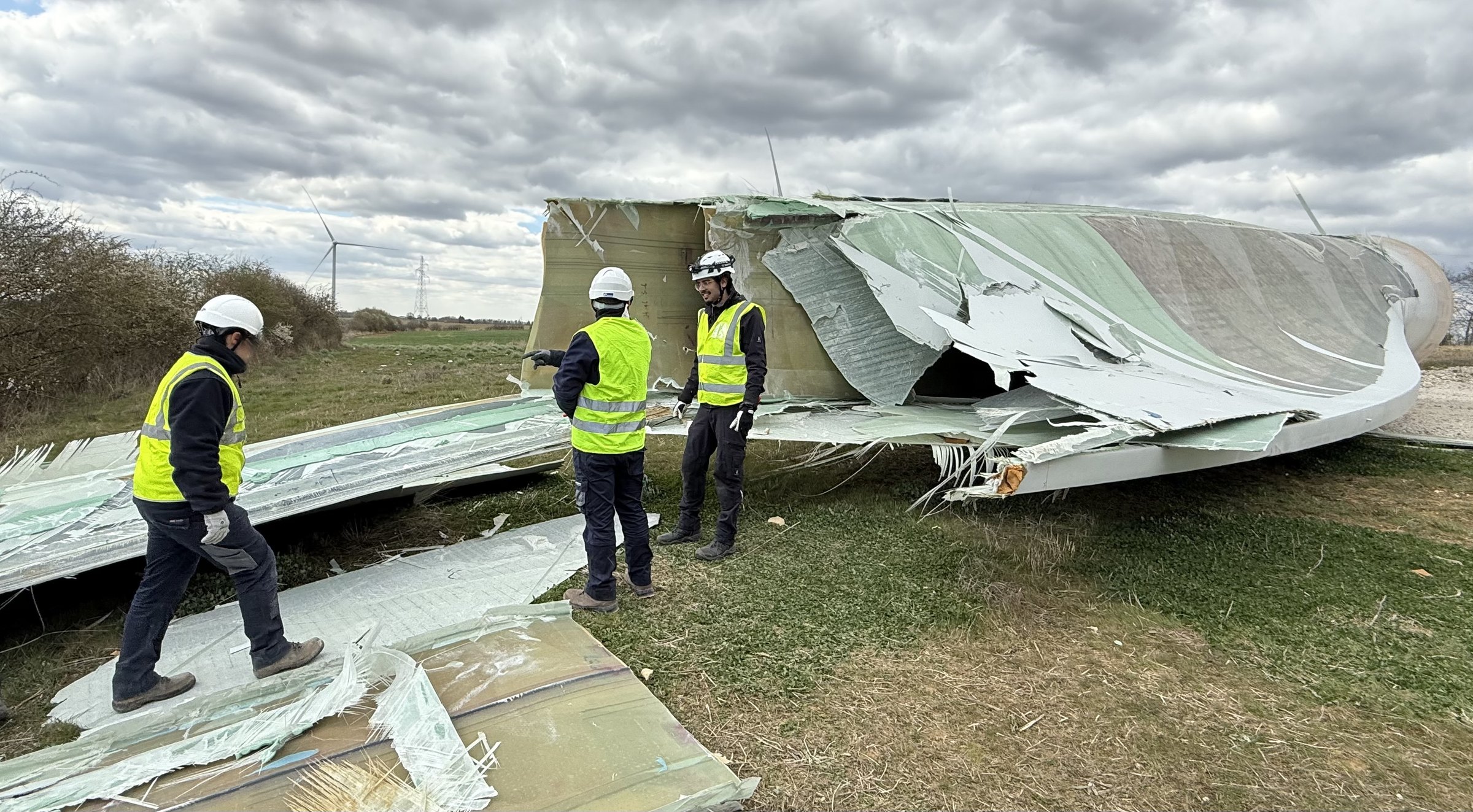
A blade failure investigation establishes the sequence of events that led to the damage and separates the initiating cause from its consequences. We work from whatever evidence is available:
- inspection imagery and drone footage
- repair and maintenance records
- SCADA and load data
- manufacturing and quality documentation
- the blade design basis
- the failed structure itself, where it can be examined
The central question is whether the failure is an isolated event or a serial defect. An isolated event is usually dealt with as a single claim. A serial defect is an exposure across the fleet, and it changes the position of every party: the owner faces repeated downtime, the insurer repeated claims, and the manufacturer a warranty and liability question. Distinguishing between the two requires an understanding of how blades are designed, laminated and tested, not only of how they appear once broken.
Our conclusions are based on the structure and the evidence, and they are written to withstand examination by another expert.
Common questions
- What is root cause analysis (RCA) of a wind turbine blade failure?
- It is a structured engineering investigation that identifies why a blade failed, rather than only describing the damage. It traces the failure back through the structure and the blade history to the initiating cause, and states whether that cause is likely to be present in other blades of the same type.
- Can you tell whether a blade failure is a serial defect?
- Often, yes. A serial defect leaves a repeatable signature: the same location, the same laminate detail, the same load path, the same manufacturing step. Establishing it needs the failed structure or its documentation compared against the design basis and, where available, evidence from other blades in the fleet.
- Do you work for insurers as well as owners?
- Yes. Apex Wind is independent of every turbine and blade manufacturer: no OEM owns us, partners with us or pays us for a referral. We sell no repairs, retrofits or hardware and take no share of the work a finding leads to, so an investigation is not a route to selling you anything. Before accepting an engagement we disclose any existing client relationship, and any interest of our own, in a party whose work it would assess, and where both parties in a dispute approach us we say so and decline the second instruction.
Articles on this topic
9 min read
Laminate wrinkle wind turbine blade: how one defect becomes a serial defectHow laminate wrinkles form in wind turbine blade spar caps, why they cut fatigue life, and how one wrinkle becomes a fleet-wide serial defect.
8 min read
End-of-warranty blade inspection: what to require, and what the OEM's own inspection will not tell youWhat an end-of-warranty blade inspection must cover, why the OEM's own inspection is not enough, and when to start so claims are made in time.
7 min read
Edgewise vibrations in wind turbine blades: causes, the damage they do, and what SCADA showsWhy blade edgewise modes are lightly damped, when edgewise vibration occurs in operation and at standstill, the damage it does, and what SCADA shows.
7 min read
Wind turbine blade delamination: causes, detection, and when it is structuralWhat causes delamination in wind turbine blades, how it is detected by tap test, ultrasound and thermography, and when a delamination is structural.
8 min read
Wind turbine blade cracks: edge, transverse and shell cracks, and what each means structurallyTransverse, longitudinal, edge, root and coating cracks on blades: what each means structurally, and how to tell a cosmetic crack from a serious one.
8 min read
Offshore blade failures: what differs from onshore, and what an independent investigation coversWhy offshore wind turbine blade failures cost more and carry larger fleet exposure, and what an independent offshore investigation has to cover.
10 min read
Blade root insert failure: why root connections fail and how to catch it earlyWhy wind turbine blade root inserts and root connections fail, the warning signs, and how to catch root failure before the blade separates.
7 min read
Blade repair decisions: what can be fixed on the turbine, what needs the blade down, and who should decideWhich wind turbine blade repairs can be done up-tower, which need the blade on the ground, what limits a field repair, and who should make the call.
8 min read
Blade failure insurance claims: what an underwriter or loss adjuster needs from the investigationWhat a blade failure insurance claim turns on: cause, defect exclusions, serial exposure and recovery, and what insurers should ask of the investigation.
9 min read
Wind turbine blade failure: causes, warning signs and how it is investigatedWhat causes wind turbine blade failure, the warning signs before it, and how an independent investigation tells an isolated event from a serial defect.
9 min read
When does blade damage require repair? Damage categories and the decision behind themWhen blade damage is cosmetic, when it becomes a water path and when it is structural: the damage categories and the repair decision behind them.
9 min read
Trailing edge cracks: what causes them, how they are diagnosed, and when they are structuralWhat causes trailing edge cracks in wind turbine blades, how they are diagnosed from inspection data, and when a trailing edge crack is structural.
9 min read
Lightning damage to wind turbine blades: diagnosis, receptor testing and what IEC 61400-24 requiresHow lightning damage to wind turbine blades is diagnosed, how receptors and down conductors are tested, and what IEC 61400-24 requires.
9 min read
Erosion, lightning or a bond line crack? How to distinguish blade damage typesHow to tell leading edge erosion, lightning damage and bond line cracks apart on a wind turbine blade, and why the distinction decides the repair.
10 min read
Wind turbine blade inspection checklist: what to check, how, and what each finding meansA wind turbine blade inspection checklist: what to check externally and internally, how to check it, and what each finding means for the structure.
9 min read
Wind turbine blade icing: production losses, loads and what owners can doHow ice on wind turbine blades costs production and adds loads, how icing is detected, and what owners can do about it before and after it forms.